
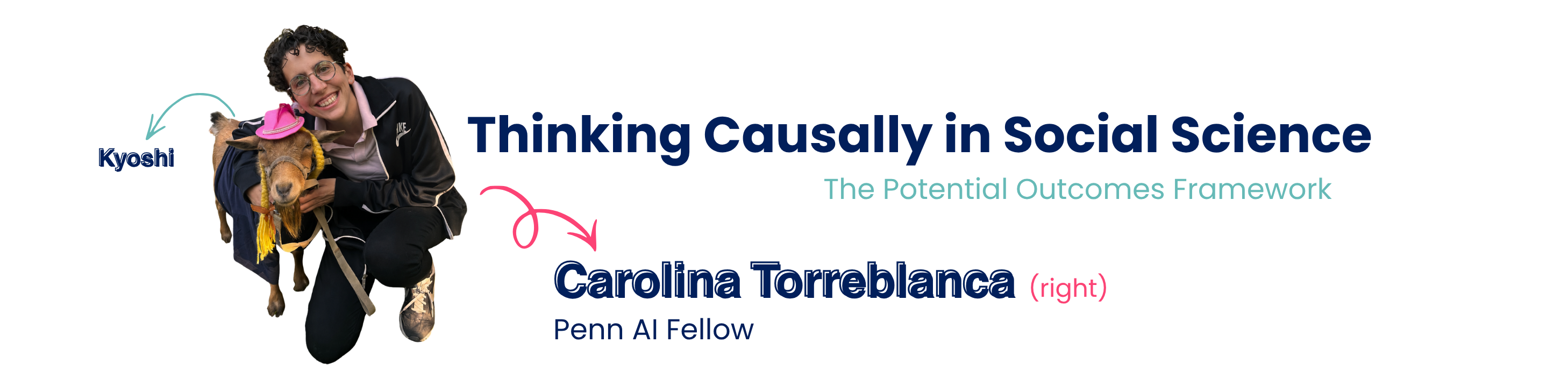

Thinking Causally in Social Science
A walkthrough of the Potential Outcomes Framework from first principles, exploring why causal claims are harder than they look and how social scientists build credible arguments
Data Points showcases the work of Penn’s data science community through concise, engaging articles. Each post takes a complex idea and transforms it into accessible insights in creative and compelling ways—whether through a high-level walkthrough of a key figure, or an interactive, explorable explanation.
Interested in contributing? We can help with technical and editorial guidance so your post is as impactful and polished as the research it represents. Check out How to Contribute - we’re excited to collaborate and help bring your ideas to life!
A walkthrough of the Potential Outcomes Framework from first principles, exploring why causal claims are harder than they look and how social scientists build credible arguments
Five Penn physicists — from HEP theorists to experimentalists to astrophysicists — share their real AI workflows in a May 2026 training session, covering symbolic computation, agentic coding, and the honest limits of trust
Postdoctoral researchers across two sessions compared model selection strategies, built MCP servers live, and debated what agentic AI means for peer review integrity and student learning
A narrative essay on how to keep sequence and evidence visible under polarization: turning fast-moving crises into structured, revisitable context
From Data to Documentation: Assisting Codebook Completion with LLMs
Ready to contribute to Data Points? Here’s how to get started:
Want to contribute a blog post? Email us!
For more details, check out our Contributor Guide.
Data Driven Discovery Initiative (DDDI)
3718 Locust Walk
Suite 411
Philadelphia, PA 19104
Follow us
Join our mailing list