


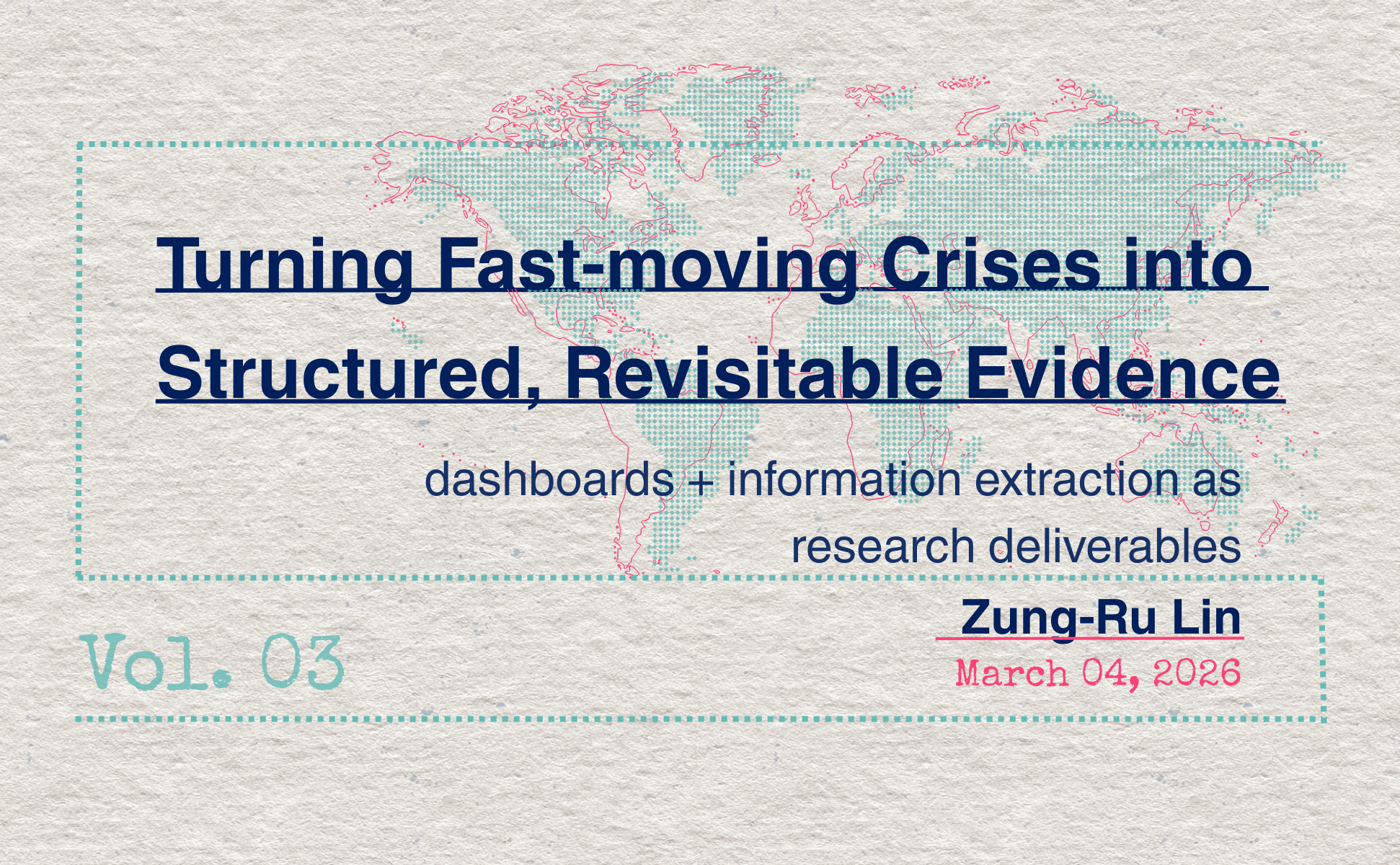
Turning Fast-moving Crises into Structured, Revisitable Evidence
A narrative essay on how to keep sequence and evidence visible under polarization: turning fast-moving crises into structured, revisitable context
Data Points showcases the work of Penn’s data science community through concise, engaging articles. Each post takes a complex idea and transforms it into accessible insights in creative and compelling ways—whether through a high-level walkthrough of a key figure, or an interactive, explorable explanation.
Interested in contributing? We can help with technical and editorial guidance so your post is as impactful and polished as the research it represents. Check out How to Contribute - we’re excited to collaborate and help bring your ideas to life!
A narrative essay on how to keep sequence and evidence visible under polarization: turning fast-moving crises into structured, revisitable context
From Data to Documentation: Assisting Codebook Completion with LLMs
A visual guide on how foundation models enhance computer vision research with small datasets.
An interactive tutorial about decomposing variation into distinctions worth making.
Ready to contribute to Data Points? Here’s how to get started:
Want to contribute a blog post? Email us!
For more details, check out our Contributor Guide.
Data Driven Discovery Initiative (DDDI)
3718 Locust Walk
Suite 411
Philadelphia, PA 19104
Follow us
Join our mailing list